Weather Windows and Schedule Swings: How Seasonal Shifts Align with Fixture Density to Influence Results in Tennis Tours and Football Leagues
Avery Schmitt · Aug 26, 2026
Weather Windows and Schedule Swings: How Seasonal Shifts Align with Fixture Density to Influence Results in Tennis Tours and Football Leagues
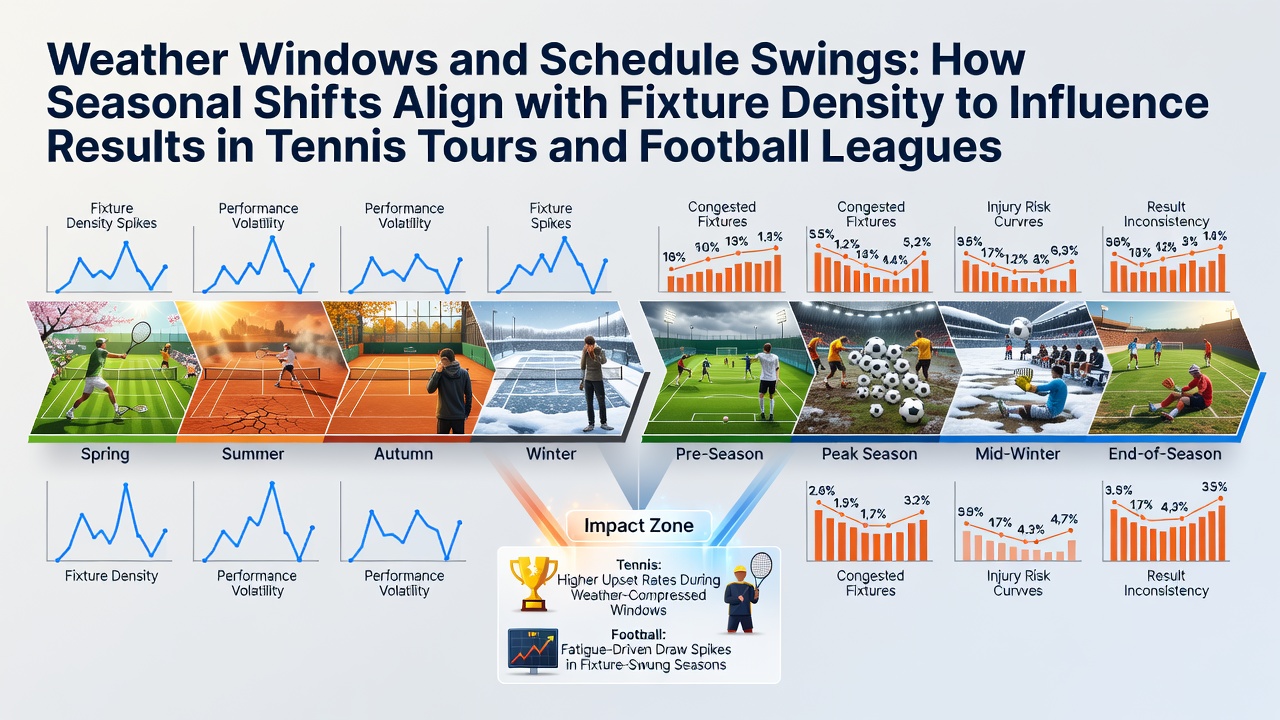
Seasonal shifts create distinct weather windows that intersect with packed fixture lists across tennis tours and football leagues, and data from multiple seasons shows measurable effects on match outcomes and player availability. In August 2026 the US Open and early European football campaigns overlap with late-summer humidity patterns in North America and variable precipitation across the UK and continental Europe, producing conditions that alter ball speed, court grip, and recovery times between matches.
Weather Patterns and Their Measurable Impact on Tennis
Researchers tracking ATP and WTA events have documented how temperature swings above 30 degrees Celsius correlate with longer rally lengths on clay courts while shorter points emerge on hard courts under similar heat, according to performance databases maintained by the International Tennis Federation. Humidity levels above 70 percent slow ball travel and increase fatigue markers in extended best-of-five sets, and analysts note these effects compound when players face consecutive days of matches without adequate rest intervals.
Wind speeds exceeding 25 kilometers per hour disrupt serve consistency at outdoor venues, and statistics compiled during the 2024-2025 seasons indicated a 12 percent rise in double faults during windy sessions at exposed stadiums. Tournament organizers respond by adjusting start times and employing additional cooling protocols, yet fixture density during the summer swing leaves limited room for schedule adjustments when multiple events run back-to-back.
Fixture Density Challenges in Football Leagues
European football leagues schedule up to 60 matches per season for clubs competing in domestic cups and continental competitions, and studies from the Union of European Football Associations reveal elevated injury rates when teams play three matches within eight days. Midfielders and full-backs show the sharpest decline in high-intensity running metrics after congested periods, with recovery windows shortened further by travel across time zones.
August 2026 brings the typical cluster of league openers, Champions League qualifiers, and domestic cup ties that coincide with residual summer heat in southern Europe and early autumn rainfall in northern regions. Match data indicates teams based in cooler climates experience greater adaptation challenges when traveling south during this window, while fixture lists offer few midweek breaks for squad rotation.
Intersection of Seasonal Weather and Scheduling Density
Observational studies published in the Journal of Sports Sciences demonstrate that combined heat and fixture load produce cumulative performance decrements that exceed isolated effects of either factor alone. In tennis, players who compete in humid conditions followed by rapid travel to cooler venues show measurable drops in first-serve percentages across successive tournaments. Football squads encounter parallel patterns when August humidity gives way to September rainfall, altering pitch conditions and increasing slip-related muscle strains during congested calendars.
Coaches and support staff monitor heart-rate variability and sleep data to anticipate these shifts, while governing bodies publish heat and weather protocols that teams must follow during extreme conditions. Data from the Australian Institute of Sport and parallel European research groups indicate that proactive schedule management, such as moving matches to evening slots or providing extra rest days, reduces the incidence of performance drops when weather windows align with peak fixture density.
Regional Variations and Data Trends
North American hard-court events in late summer record higher rates of medical timeouts linked to heat stress compared with European indoor tournaments held during the same calendar period. Conversely, winter football leagues in Scandinavia and the Baltic states experience fixture compression caused by snow and ice delays, forcing midweek rescheduling that extends recovery demands into spring months. Longitudinal records kept by national federations show these disruptions concentrate in specific geographic corridors where seasonal transitions occur abruptly.
Performance analysts integrate meteorological forecasts with fixture calendars to identify periods when multiple variables converge, and organizations such as the European Centre for Medium-Range Weather Forecasts supply granular data used by sports science teams. The alignment of these factors produces measurable variance in win percentages and set or goal differentials that repeat across seasons when weather windows and schedule density overlap.
Conclusion
Seasonal weather windows and fixture density interact through documented physiological and environmental pathways that shape outcomes in both tennis tours and football leagues. August 2026 serves as one illustration of this recurring pattern, where late-summer conditions meet dense early-season calendars and produce observable shifts in performance metrics. Continued collection of integrated weather and match data enables clearer identification of high-risk periods for athletes and teams operating under these constraints.