Venue Variables and Their Ripple Effects on Cross-League Selection Strategies
Sofia Klein · Nov 8, 2026

Venue Variables and Their Ripple Effects on Cross-League Selection Strategies
Venue variables shape selection strategies across soccer leagues, basketball conferences, tennis circuits, and horse racing tracks because surface type, altitude, climate controls, and crowd proximity alter performance metrics in measurable ways. Data from major competitions indicate that home teams secure victories at rates between 55 and 65 percent in domestic leagues when accounting for travel distance and rest intervals, while neutral-site events compress those margins.
Core Venue Elements Across Disciplines
Researchers track pitch dimensions in soccer, court hardness in basketball, court speed ratings in tennis, and track surfaces in racing because each factor produces distinct statistical signatures. European soccer records show that narrower pitches reduce crossing attempts by 12 to 18 percent, which in turn lowers expected goal outputs for wide-oriented squads. NBA analytics groups note that high-altitude arenas such as those in Denver correlate with elevated three-point volumes, with visiting teams adjusting rotation minutes to preserve defensive energy. Tennis data compiled by the International Tennis Federation reveal that slower clay courts extend rally lengths, prompting coaches to prioritize endurance specialists during draw construction.
Cross-League Interaction Patterns
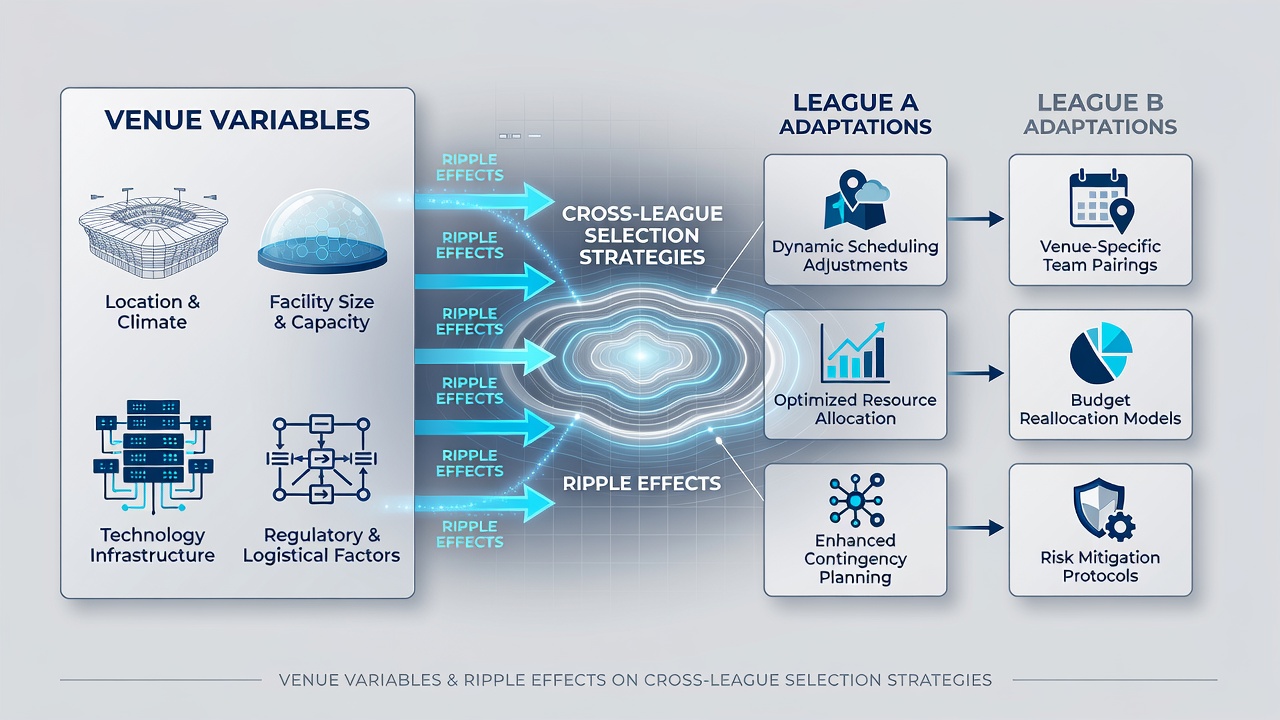
Selection models that combine data from multiple sports reveal consistent ripple effects when venue conditions shift. A squad favored in domestic play may see its projected edge shrink when transferred to a neutral venue with different dimensions or climate controls. November 2026 schedules include several high-profile neutral-site basketball events in Europe and Asia where travel fatigue and unfamiliar lighting combine to alter rotation decisions for NBA development squads. Observers note that these same variables appear in European soccer winter breaks, where indoor training facilities influence fitness baselines before resumption on outdoor pitches.
Quantitative Evidence from Recent Seasons
Studies published by the University of Queensland's sports performance unit examined 2,400 soccer matches and 1,100 basketball games across three continents and found that surface temperature differentials above 8 degrees Celsius correlate with measurable drops in sprint frequency. Those findings prompted several professional organizations to integrate venue-specific heat mapping into pre-match preparation. Parallel work from Canadian university laboratories on tennis surfaces documented serve-speed reductions of 4 to 7 percent on outdoor hard courts during high-humidity periods, data now referenced by coaches when constructing daily lineups for multi-surface tournaments.
Strategic Adjustments in Accumulator Construction
Analysts who build multi-sport selections adjust probability weightings once venue parameters enter the model. Historical basketball figures indicate that back-to-back road games in arid climates produce a 9 percent decline in fourth-quarter scoring efficiency, while soccer teams returning from high-altitude fixtures show elevated injury incidence in subsequent domestic rounds. These patterns encourage cross-league selectors to diversify exposure rather than concentrate on single-league accumulators when venue clusters appear on calendars. November 2026 fixtures already list several overlapping windows where European soccer clubs and NBA teams share similar travel burdens, prompting quantitative teams to recalibrate correlation matrices ahead of those dates.
Regulatory and Data Infrastructure Developments
Governing bodies continue to standardize venue reporting requirements. The Australian Sports Commission maintains an open database of track and field surface measurements that researchers cross-reference with international soccer and basketball datasets, while the NCAA publishes annual arena environment summaries used by scouting departments. These resources allow selection algorithms to incorporate variables such as average wind speed at racecourses or average crowd density indices at indoor arenas without relying on anecdotal adjustments.
Conclusion
Venue variables generate measurable shifts in performance distributions that propagate across league boundaries. Organizations that embed surface, climate, and logistical data into unified models produce selection outputs that reflect documented patterns rather than isolated league trends. Continued expansion of shared datasets from North American, European, and Asia-Pacific sources supports increasingly precise cross-league calibration as schedules evolve through 2026 and beyond.